
Dear RCC members
I recently read that Adam Yates was involved in a 30-rider crash in the Giro d’Italia and although he finished the stage covered in blood he has been withdrawn from the race by his team.
This got me thinking about just how dangerous cycling is, not just as a sport, but every day on our local roads and tracks. I won’t say uniquely dangerous, as from my experience skiing both as a sport and as a pastime is just as dangerous, but we don’t routinely ski to work or school, at least not here in Reading.
To try to get a handle on just how dangerous cycling is, I have been looking at the government’s latest accident statistics for 2020-2024: https://tinyurl.com/mak7m8z4. These show that during that year there were 14,545 casualties of which 82 were fatalities.
These are the lowest figures in a data set going back twenty years to 2004 where the comparable figure were 16,648 and 134 fatalities. The trend is obviously in the right direction, but 82 is still 82 too many.
Over the last four years for which we have data, fatalities are down, although still two a week on average, while serious injuries are up 16%. Cycle traffic is said to be up 36% over this period according to the National Road Traffic Census so things are getting better relatively.
Drilling down into the data, we find that male cyclists are five times more likely to be hurt or killed than female ones, and that the 30 – 60 age range had the most accidents. Most of the casualties were because of a collision with another vehicle, and heavy goods vehicles (or their drivers) seem to be the worst offenders.
The report states that the biggest contributory factor to these accidents as ‘ineffective observation by either the driver or rider or pedestrian’. In other words, “Sorry Guv, I didn’t see you”. Over the years this has happened twice to me – oddly enough at both ends of Bridge Street alongside the Oracle.
However, over a four-year period, 84 cyclists were killed in accidents which did not involve another vehicle. How do we account for this as the report makes no comment?
Is cyclist inattention a factor? Every young cyclist I see seems to be looking at a mobile phone.
Is deteriorating road surfaces another factor? I have twice come off my bike after hitting an unseen hole in the road.
Is it the increasing use of illegal e-bikes that often seem to be ridden without any respect for road rules or even common sense?
But how do you have a bad enough crash to kill yourself without being hit by several tons of motor vehicle?
If you have suggestions, I’d be interested to hear your views – please post a reply in the comment box below, or on our Facebook page, if you can shed some light on it or have personal experience.
When we ask people why they do not cycle, one of the most common reasons given is that it is too dangerous. The statistics seem to show that cycling is getting relatively safer, with accident rates per mile travelled decreasing and especially fatalities.
But, of course, this is not the whole story, as reporting rates of non-fatal accidents is still too low and near misses are hardly ever recorded. Knowing the statistics will not persuade a lot more people onto bikes, but it is a start. Better driving training, more cyclist training and perhaps better enforcement of traffic regulations would all help.
Please let me know your views.
Joe Edwards
RCC Chairman
(chair@readingcyclecampaign.org.uk)
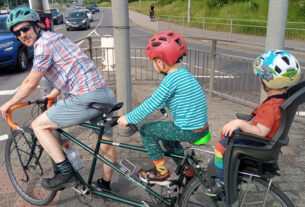

Education is key, reaching cyclists either this education is likely to be a real challenge to, luckily there is cycle training at School but it is rudimentary and statistics shows it’s probably not enough. I did not have that school training, I have read other reports about two wheels and the statistics are even more shocking with bikers only making around 6% of road but involved in 20% of all accidents, there was a statistic about how many over 30 miles an hour and involving head injuries were fatal and it was 40% where as for cars negligible.
Maybe another way would be also to implement compulsory cycle safety training by cyclists for car drivers that heavy goods vehicles have to go through. The recent changes to the high way code to prioritise cyclists and more vulnerable road users is a step in the right direction.