
What you need to know
A plain-English guide for everyday riding: where you can cycle, what equipment is legally required, and a few common myths worth retiring.
Introduction
If you cycle to work, nip to the shops, ride with family at weekends or head out on club runs, you’ve probably heard confident claims about what cyclists ‘can’ and ‘can’t’ do. This article pulls together the basics of UK cycling law and the Highway Code, with a focus on the questions that come up most often.
A quick note: I’m not a lawyer. I’ve summarised information from reputable sources (see References) and I believe it to be accurate at the time of writing, but it isn’t legal advice.
Key takeaways (if you only read one thing)
- You can ride on most roads (including many bus lanes), but not on motorways or where a ‘No Cycling’ sign is shown.
- Cycle lanes and tracks usually aren’t compulsory — use your judgement about what feels safest.
- It’s legal to ride two abreast and it can be safer in groups or with children.
- Pavements aren’t for cycling unless they’re signed for shared use or as a cycle track.
- Red lights apply to cyclists too (including at junctions and advanced stop lines).
- At night you must have lights, and there are specific reflector rules that catch people out (especially clipless pedals).
Where you can ride, and how
General
In this article I’ll use the generic term highway to mean any public route: roads, paths, tracks and similar rights of way.
This is the area that tends to generate the most confusion (and the loudest internet arguments). One common myth is that only motorists are ‘allowed’ on roads because they pay ‘Road Tax’. In fact, Road Tax was abolished in the 1930s; today drivers pay Vehicle Excise Duty, which goes into general taxation rather than being ring-fenced for roads. And, of course, many cyclists also drive and pay it too.
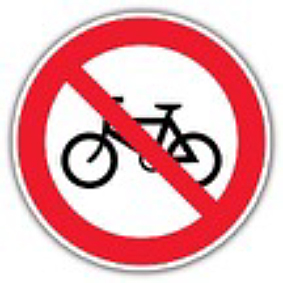
You may ride on most roads (including bus lanes marked with a cycle symbol). You must not ride on motorways, or on roads/paths where cycling is specifically prohibited — look out for the sign shown here, sometimes with a separate “No Cycling” plate underneath.
The Highway Code is clear that cycle lanes and tracks are there to help but are not usually compulsory: you can choose whether to use them based on your skills, experience and what feels safest at the time.
If there is no safe cycle facility, the Highway Code recognises that it can be appropriate to ride in the centre of your lane (often called the ‘primary position’) — for example on quieter roads, approaching junctions, or where the lane is too narrow for a vehicle to pass safely within it. Move left only when it’s safe and makes sense for you to do so.
In practice: If someone behind is clearly impatient, it can be tempting to ‘hug the kerb’. Don’t. Prioritise avoiding potholes, drains and door zones — and choose a position that discourages unsafe close passes.
Riding two abreast is legal and recognised in the Highway Code. It can be safer in groups or when accompanying children, because it improves visibility and can shorten the length of a group. As always, be considerate and allow drivers to overtake when it’s safe and appropriate.
Pavements, footpaths, shared paths and crossings
In general, you must not cycle on the pavement (the footway alongside a road) unless it’s signed as a shared-use path or a cycle track. In practice, enforcement often uses discretion — especially for children or where the alternative is a fast, intimidating road — but it’s still best to use a signed route where possible.
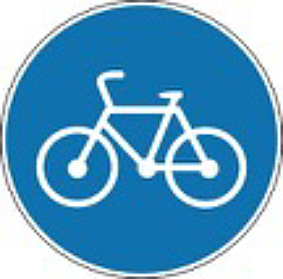
Dedicated cycle paths should be indicated by the sign shown here. The path itself is often marked with cycle symbols, as shown here.
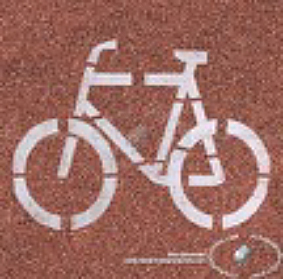
If it is part of a road, it may also use coloured tarmac, generally either red, blue, or green. It should be separated from the rest of the road by either some form of barrier or a solid white line, in which case it is mandatory and other vehicles are not allowed to use it during operational hours, or a dashed white line, when the lane is advisory and other vehicles are allowed to use it, even for parking.
Shared-use paths may mix cyclists and pedestrians or segregate them. On all shared-use paths, give pedestrians plenty of space, be ready to slow or stop (especially around children, older people and disabled people), and keep to the cycle side where the path is divided (although which is the cycle side is often not clear).
If a shared path runs alongside a high-speed road, choosing the path can be the safer option for many riders — even if not everyone agrees. I have been shouted at: “You should be on the road!” on the shared use path along the A4 between Charvil and the Wargrave roundabout, where the road has a 60mph limit. No, thank you, not with the speed and density of motor traffic along there!
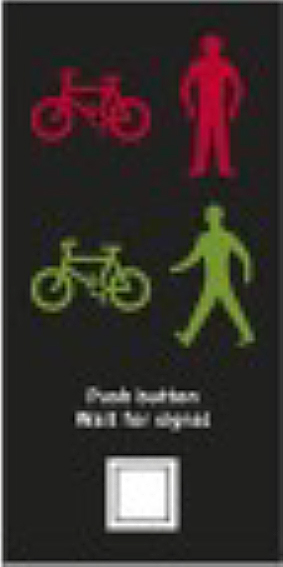
You may ride across toucan (‘two can’) crossings and cycle‑only signalised crossings when the green cycle symbol shows, but you should not ride across other pedestrian or equestrian crossings; you should dismount and wheel your bike.
Other highways
For other types of highways (especially in the countryside), the labels can be confusing. Here’s a quick guide.
- Footpath: A right of way primarily for walking. Footpaths are often just tracks, and are rarely surfaced or lit outside of built-up areas. Confusingly, some routes signed as ‘Public Footpath’ also allow cycling (because of additional rights or designations) but that relies on riders knowing the local situation. For example, parts of National Cycle Network Route 4 beside the Thames and Kennet through Reading are signposted with ‘Public Footpath’ notices but also have ‘NCN 4’ signs.
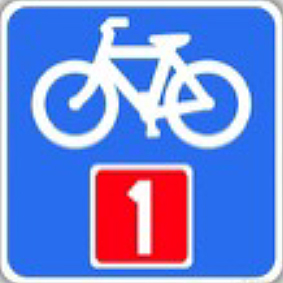
- National Cycle Network (NCN): A nationwide set of signed routes. Some are on roads, some on unmade tracks, and many are somewhere in between. Signs typically have a blue background with white writing/symbols, with the route number in a red box. some have distances to local locations and look similar to road signposts but use the blue-white-red colour scheme.
- Bridleway: Open to walkers, horse riders (and people leading horses) and cyclists. Cyclists should give way to pedestrians and horse riders. Bridleways are not necessarily surfaced, so a well-used bridleway can become muddy and difficult for all but the most determined riders.
- Byway open to all traffic (BOAT): A right of way for all kinds of traffic, though in practice often used mainly for walking and horse riding. BOATs are not usually surfaced and can get very wet and muddy.
- Restricted byway: Created under the Countryside and Rights of Way Act 2000. A restricted byway allows travel on foot, by bicycle (including legal e-bikes), on horse-back (or leading a horse), and by vehicles other than mechanically propelled vehicles.
- Permissive path: A route where a landowner allows access without dedicating a permanent right of way. They can close or divert it without the usual legal process, and they can set conditions (for example allowing walking but not cycling, or vice versa). Permissive paths are often on land owned by organisations that allow public access, such as local authorities, rail organisations, or the National Trust.
Traffic lights, junctions and roundabouts
Traffic signs and signals apply to cyclists too. Crossing the stop line at a red light is an offence, just as it is for drivers (though cyclists don’t receive licence penalty points).
At junctions with advanced stop lines (bike boxes), you may enter the box when the light is red, but you must not cross the second stop line until the signal turns green. These boxes work best when everyone keeps the markings clear. Motor vehicles are not permitted within the box under red lights.
At roundabouts, you are entitled to take the appropriate lane like any other vehicle, and the Highway Code advises positioning yourself centrally in your chosen lane, watching for vehicles entering and leaving and giving extra room to long vehicles.
Your bike: what the law actually requires
Brakes
Your bike legally needs two independent braking systems, normally a front and rear brake. If you ride a ‘fixed wheel’ bike, that is one with no freewheel, where the pedals are directly linked to the rear wheel, that also counts as a brake for that wheel, but you still need a working brake on the other wheel. So, you cannot ride a ‘fixie’ with a brake only on the rear wheel. I have no idea how this applies to unicycles and bicycles such as penny-farthings.
Lights and reflectors
At a glance: if you ride between sunset and sunrise, your bike must show a white light at the front and a red light at the rear, and it must have a red rear reflector (plus amber pedal reflectors if the bike was manufactured after 1 October 1985).
Flashing lights are permitted, as long as they flash at an even rate between 1 and 4 flashes per second (60–240 per minute). Many people use a steady light to see where they’re going and an additional flasher to help them be noticed.
One practical ‘gotcha’: the legal requirement for amber pedal reflectors can be awkward if you use clipless/cleated pedals, because many systems don’t accept reflectors.
If you regularly ride after dark, it’s worth checking your setup (some pedals take clip-in reflectors, and some riders keep a second set of pedals for winter/commuting). Reflective clothing is great for visibility but doesn’t replace the legal reflector requirement.
Other equipment
You are not legally required to have a bell, helmet, hi‑vis, or special clothing, although new bikes must be sold with a bell and the Highway Code recommends a helmet and visible clothing.
Behaviour: ‘must nots’ and common myths
You must not ride dangerously, carelessly or inconsiderately; carry passengers on a bike not designed for them; hold on to moving vehicles; or ride while under the influence of drink or drugs. Serious offences can lead to heavy fines and, in extreme cases, a driving disqualification or even prison.
A lot of frustration between road users comes from mixing up what the Highway Code recommends with what the law requires. For example: you’re not legally required to wear a helmet, hi-vis or special clothing; you don’t have to have a bell; and cycle lanes generally aren’t compulsory. However, some of these ‘shoulds’ can still be sensible choices depending on the road, the weather and your confidence.
Frequently asked questions
Here are some quick answers to common Berkshire/Wokingham questions:
Can I cycle on riverside paths and towpaths in Berkshire (Thames/Kennet and local parks)?
It depends on the route. Some riverside paths are public footpaths (walking only), while others are signed as shared-use or a cycle track. If you’re unsure, check for signs at entrances, bridges and junctions. Where paths are busy or narrow, slow right down, give way, and consider a nearby on-road/NCN alternative.
How should I ride on narrow rural lanes around Berkshire (blind bends, fast A/B roads, horse riders)?
On narrow lanes, ride far enough out to avoid being “squeezed” past, and consider the centre of the lane at blind bends, crests and pinch points. Use passing places where they exist; if you choose to let a queue go, do it somewhere you can pull in safely and rejoin without a close pass. Expect horses and farm vehicles — slow down early, be patient, and give plenty of space.
Is it legal to ride two abreast?
Yes. It’s recognised in the Highway Code and can improve visibility, particularly in groups or when riding with children. Be considerate and, where appropriate, move into single file to help vehicles overtake when it’s safe.
Can I cycle on the pavement (especially with a child)?
Not unless it’s signed for cycling (shared use or cycle track). Discretion is sometimes used — particularly for children — but the safest option is usually a signed route, a quiet street, or a protected cycle track where available.
What are bike boxes (advanced stop lines) and can I use them?
They let cyclists wait in front of motor traffic at junctions. You may enter the box on red, but you must not cross the second stop line until the signal turns green. If the box is full, wait behind the first stop line.
Can I use bus lanes around Berkshire (including routes into Reading/Wokingham/Bracknell)?
Often, yes — but it depends on the signs (and sometimes the time of day). Many bus lanes allow cycles and are marked accordingly, but restrictions vary by location, direction and operating hours. If in doubt, follow the signs for that stretch.
There’s a dangerous pothole / broken drain cover (or mud/hedge cuttings) on my regular Berkshire route—what should I do?
If it’s an immediate danger, report it as urgent to the highway’s authority. Otherwise, use the relevant Council ‘report a problem’ service (for example Wokingham, West Berkshire, Bracknell Forest or Reading, depending on the road). Include the exact location and, if possible, a photo — rural-lane hazards can change quickly.
What do I legally need at night?
Between sunset and sunrise you must have a white front light, a red rear light, and a red rear reflector. Many bikes (manufactured after 1 October 1985) also need amber pedal reflectors — worth checking if you use clipless pedals.
References
Cycling UK: ‘What’s legal – and what’s not – on your bike?’: https://tinyurl.com/32k8ucje
Highway Code UK: ‘The Highway Code Rules for Cyclists‘: https://tinyurl.com/2kpfpeda
The Ethical Choice: ‘A no-nonsense guide to UK cycling law’: https://tinyurl.com/yr88ux28
UK Department of Transport, ‘The Highway Code Rules for Cyclists’ ,October 2025: https://tinyurl.com/3mzphtaf
ElawDaily: ‘What Are the Cycling Laws in the UK?’, March 2025: https://tinyurl.com/yc48954w
House of Lords Library: ‘Cyclists and the Law’, August 2024: https://tinyurl.com/4j3kfucc
LawyerMag: ‘Cyclists Rights and Accident Law in the UK’, June 2025: https://tinyurl.com/bdzfvwsz
I hope you’ve found this article useful. If there are other cycling-law questions you’d like the committee to cover in future, please include them in the comments below, or contact us via the website. Happy (and safe) cycling!
Keith Collyer
RCC Membership Secretary
Essential reading for any cyclist. All to often I see four wheeled cars and vehicles use the traffic light designated cycle junction zones.