
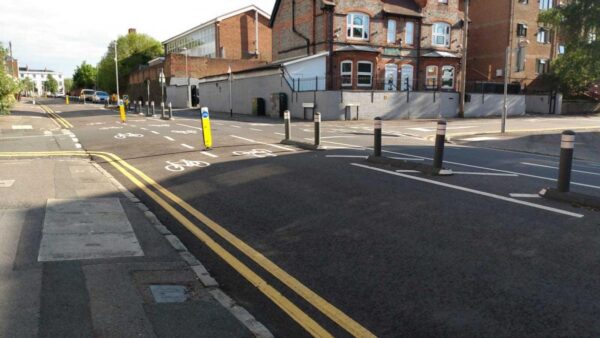
At the Reading Borough Council meeting on Tuesday, 23 April 2024, a routine discussion on the borough’s Local Transport Delivery Plan escalated into a wider clash over the Sidmouth Street cycle lane and whether Reading should consider introducing a Low Emission Zone (LEZ). The exchange, recently reported in the Reading Chronicle, once again highlighted how cycling infrastructure becomes the focal point for broader frustrations about transport, funding, and political priorities.
The Reading Chronicle report on councillors clashing over the Sidmouth Street cycle lane and the possibility of a Low Emission Zone (LEZ) has once again highlighted a familiar pattern in Reading’s transport politics: cycling infrastructure becomes the lightning rod for wider frustrations, while the structural issues behind our congestion, pollution and funding challenges remain unaddressed.
Here we take a look at what the debate reveals and what Reading must do if it is serious about cleaner air, healthier residents and a modern transport system.
Air Quality, Sedentary Lifestyles and Reading’s Transport Plan
During the council debate, Cllr John Ennis emphasised the growing problem of sedentary behaviour and the role active travel can play in addressing it. He also acknowledged that many residents still rely on cars and will continue to do so.
This is an important point. Reading’s transport system must support those who need to drive, while also enabling those who want to walk or cycle to do so safely. Yet the borough’s Local Transport Delivery Plan, a multi‑million‑pound bid for government funding, risks becoming another document full of good intentions without the long‑term commitment needed to deliver real change.
The plan includes:
- Improvements to bus journey times
- Expansion of electric vehicle charging
- Active travel schemes
- Measures to reduce emissions
But without a coherent strategy that prioritises safe, continuous cycling routes these measures will struggle to shift travel behaviour in any meaningful way.
Sidmouth Street: A Case Study in Short‑Termism
The Sidmouth Street cycle lane has become a symbol of Reading’s inconsistent approach to active travel. Originally installed using emergency COVID‑19 funding to support socially distanced travel, it is now being considered for partial removal to create an additional turning lane for motor traffic.
Opposition councillor Dave McElroy described the situation as “frustrating and disappointing,” arguing that installing a cycle lane only to shorten it later represents a waste of time and resources. Many in the cycling community agree. However you dress it up, removing a cycle lane without providing an alternative is not a good look for the Council.
The deeper issue is not the lane itself, but the stop‑start nature of transport planning in Reading. The scheme was funded through a competitive national bidding process, described by one councillor as a “Hunger Games‑style system”, which forces councils to scramble for short‑term pots of money rather than plan strategically.
This leads to:
- Isolated cycle lanes that don’t connect
- Projects that are vulnerable to political shifts
- Infrastructure that is installed quickly and removed just as quickly
- Public confusion and declining confidence in the council’s transport vision
Sidmouth Street is not an isolated case. It is a symptom of a system that rewards speed over strategy.
The LEZ Debate: A Distraction From the Real Work
The idea of a Low Emission Zone in Reading surfaced during the debate, with some councillors questioning why it was not being considered. LEZs can be effective tools for reducing pollution, but they are not a silver bullet and they are certainly not a substitute for a robust active travel network.
If Reading is serious about reducing emissions, the evidence is clear: the fastest, cheapest, and most effective way to cut pollution is to enable more people to cycle.
What Reading Actually Needs
To move beyond reactive debates and piecemeal schemes, Reading must commit to a long‑term, evidence‑based transport strategy. That means:
- A continuous, protected cycling network linking neighbourhoods, schools, workplaces and the town centre
- Safe junctions, where most cycling collisions occur
- Secure cycle parking, especially at stations, shopping areas, and residential developments
- Traffic‑calmed neighbourhoods, making walking and cycling the natural choice for short trips
- Reliable, long‑term funding, not competitive bidding rounds that force rushed decisions
- Integration with public transport, enabling seamless multimodal journeys
- A commitment to maintain and improve existing cycle lanes, not dismantle them when political winds shift
These are not radical ideas. They are standard practice in cities that have successfully reduced congestion and improved air quality.
Our Message to Councillors
The Reading Cycle Campaign urges councillors to stop treating cycle lanes as expendable experiments or political symbols. Every time a scheme is watered down or reversed, public trust erodes and progress stalls.
Reading deserves a transport system built on evidence, not short‑term politics. A system that supports those who need to drive, while giving everyone else safe, attractive alternatives. A system that prioritises health, sustainability and long‑term thinking.
The debate over Sidmouth Street and the LEZ is a reminder that Reading stands at a crossroads. The choices made now will shape the town’s transport landscape for decades.
Let’s choose a future where cycling is safe, convenient and central to Reading’s identity, not an afterthought.
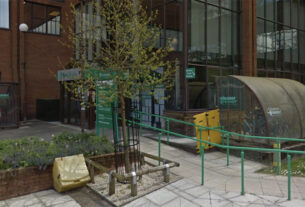
The is a good example of a poorly planned and confusing cycle lane, no sign posting and some may say confusing with the other junctions and bollards that takes several attempt to even understand what is going on here or even if it is a cycle lane. The other points about the transport plan are clear when you look at the road painting for cycle lanes vanishing after a year or two. The transport strategy may seem well intended but I do not believe it’s best interest is anything other then self serving at the moment possibly being funded at the hands of the greater local economy, there maybe some inroads such as the new electric buses but even the same issues persist with shared lanes that could be used not just for taxis and buses but other two wheeled vehicles such as cycles and motorcycles to reduce emissions and the crux of the argument. Everything in Reading is designed around the car, it should not be that way but it is, the drive throughs, the traffic lights waiting times at busy pedestrian junctions and everything else, curbing this trend is the real issue at heart and I think it is very unlikely to change unfortunately. I think way more data needs to be collected even on buses traffic lights could use Google maps data for road directions peak times but it seems seldom done.