
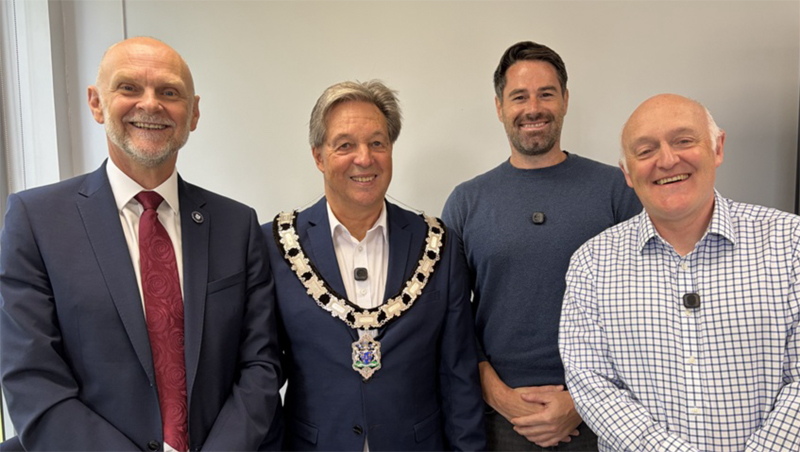
The Mayor of Reading has offered a candid assessment of the town’s cycling network, admitting it remains incomplete and warning that the £2.84 million allocated to Reading for active travel will not be enough to join it up as he would like.
Councillor Paul Gittings, who is also a Bikeability instructor in Reading schools, was speaking on a new episode of the University of the Built Environment’s BE Sustainable podcast, which asks whether British towns can ever become places where cycling is an ordinary, everyday way to travel.
Using Reading as a case study, the Mayor joined Cycling UK Chair of Trustees Professor Ashley Wheaton (and formerly Vice Chancellor of Reading-based University of the Built Environment), Netherlands-based urban mobility advocate Melissa Bruntlett, and Reading cyclist and author Jason Wride, to discuss the money, infrastructure and cultural change needed to get more people on bikes.
The Department for Transport July 2026 allocation table has given Reading £2,844,014 in active-travel funding across 2026/27 to 2029/30.
But Paul Gittings acknowledged the difficulty of stretching this funding across the town.
“I’m the first to admit that it’s incomplete,” he said of Reading’s current cycling infrastructure. “They take a long time to deliver and they are extremely costly.”
Referring to the funding available to connect and extend routes, he added: “It’s nowhere near enough money to connect the network as we would want.”
Paul Gittings highlighted Reading’s existing network of riverside routes and pathways as an opportunity, saying it is already possible to travel from Thames Valley Park across much of the borough without encountering a car.
The problem, he argued, is joining those sections to the places people actually need to reach.
“We need to join up the network to exploit that,” he said.
The Mayor’s comments come as Reading continues work on active travel schemes including routes along Bath Road and Shinfield Road. However, Paul Gittings said building segregated cycle routes could only be part of the answer. Changing the behaviour of drivers was equally important.
“We should make more use of our roads as well and make sure that driver behaviour changes quite radically,” he said. “Good infrastructure and driver behaviour, the two go hand in hand.”
It is a subject close to home. As well as teaching children to cycle through Bikeability, Paul Gittings is a keen cyclist and triathlete himself. His son Matt Gittings is a two-time British Elite Derny national cycling champion.
The Mayor also questioned whether Britain is making the most of the investment already going into teaching children to ride.
Reading Borough Council has a target of 1,500 children undertaking Bikeability training each year, teaching skills ranging from basic bike control to cycling on roads and negotiating more complex junctions.
Paul Gittings praised the programme but admitted there was a disconnect between learning how to cycle and children then using their bikes for everyday journeys.
“Bikeability has been a massive success,” he said. “It’s a great programme, but it probably isn’t succeeding in terms of children getting on their bikes.
“We do need to do more school streets and those types of things to get more children cycling.”
Ashley Wheaton echoed the Mayor’s concerns about fragmented infrastructure.
“Most people don’t feel safe to cycle,” he said. “We have to have cycleways where people both feel safe first of all, and are actually safe. Those cycleways have to connect with each other so that you don’t run out of cycleway and then onto a roadway.”
Ashley Wheaton, who has himself been knocked off his bike while commuting into Reading, described investment in cycling infrastructure nationally as “piecemeal”, “sporadically funded” and “underfunded”.
But both men argued the conversation should extend beyond cycle lanes to the wider benefits of making cycling an easier choice, from improving health and air quality to reducing congestion.
For Paul Gittings, who previously held responsibility for adult social care at Reading Borough Council, the link with public health is particularly significant.
“We’ve got a massive health crisis in this country,” he said. “We’ve also got a massive climate crisis, and we need to make this a priority.”
The BE Sustainable episode also looks at what Reading and other British towns could learn from the Netherlands, where cycling is treated as everyday transport rather than primarily as sport or recreation.
The discussion asks whether Britain needs to rethink the way road space is shared, why women remain less likely to cycle than men, and what would need to change before parents felt confident allowing their children to cycle independently.
You can listen to the BE Sustainable podcast from the University of the Built Environment: ‘Can British towns ever become cycling towns, or are we kidding ourselves?’ via this link: https://tinyurl.com/yz8fxsps
Linda Serck

