
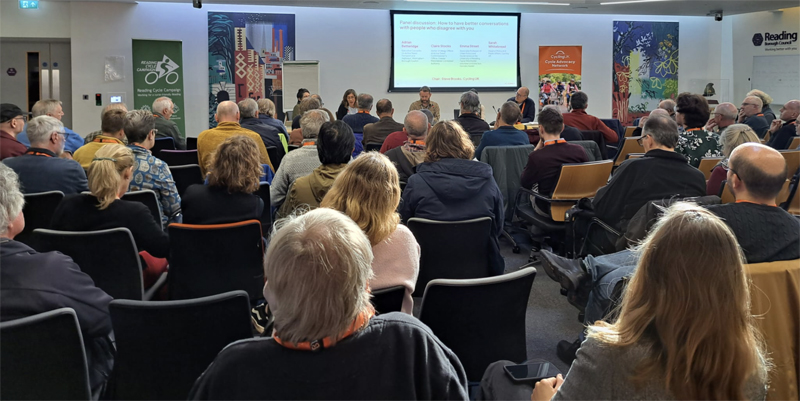
A Round-Up of the Cycle Campaign Conference
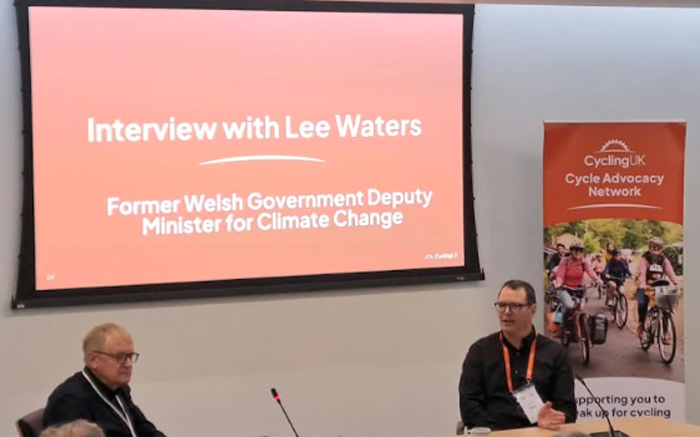
Lee Waters served in the Welsh government as deputy minister for economy and transport from 2018–21 and then deputy minister for climate change from 2021–24.
He’s perhaps most famous (or infamous depending on your viewpoint) as being a central figure in the introduction of the 20mph limit across most Welsh roads which were previously 30mph zones.
Lee was one of the speakers at the national Cycle Campaigners conference, which was held in Reading’s Civic Centre on a cold, bright Saturday in November. This was the first time such an event had been held in Reading and was jointly organised by Cycling UK and Reading Cycle Campaign.
The one-day conference, titled ‘Reframing the Message’, was used for delegates to explore and learn the most effective messaging techniques for talking about cycling in a positive, inspiring way.
But back to Lee and the controversial Welsh 20mph policy. The change to a default 20mph speed limit was implemented in September 2023, and by 2025 it was reported that casualties on 20mph and 30mph roads had dropped by a quarter, and on average the lower speed limits had added just two minutes to a typical journey.
Whilst the statistics show the policy to have been a success in improving road safety, it undoubtedly generated a tide of anger and toxic backlash, with the governing politicians like Lee taking the vitriol.
At the conference Lee was asked if campaigners for lower speed limits had helped him in swaying over a sceptical public. His reply was he had perceived them as being “smug and self-righteous” and he felt they had been a hindrance rather than a help.
If you are a campaigner for lower speed limits and safer roads this is probably not an easy thing to hear. It should also prompt all of us who advocate for cycling to have a hard look at just how we get our message across.
Before Lee took the stage, Chris Boardman addressed the conference by video, which you can watch below or via https://tinyurl.com/n62235y4.
Chris’s message to the assembled delegates was that quoting statistics and trying to win the argument won’t win over the hearts of those who are not interested or sceptical.
The message needs to be personal; it needs to relate to what they value and what they want. Chris gave the example of asking a parent if they would like their kids to be able to travel independently, rather than having to ferry them about in their car. You can then naturally move on to how you could achieve that result.
Duncan Dollimore, Cycling UK’s Head of Campaigns, followed up on Chris Boardman’s message. For too long we have tried to persuade with statistics and engaged ourselves in trying to argue against negative tropes.
Duncan’s advice is instead we need to focus on the outcomes and benefits of cycling, and consciously avoid getting drawn into us versus them narratives.
Duncan emphasised the need to highlight the personal and local benefits of cycling: enabling a choice of how you want to travel, having freedom to get around quickly and reliably, providing cheap transport when so many costs are rising. We also need to get across that cycling is a normal everyday activity for all sorts of different kinds of people.
The conference also explored how advocates for cycling should engage with their local Council, with a number of speakers being current or former Councillors in different parts of the country.
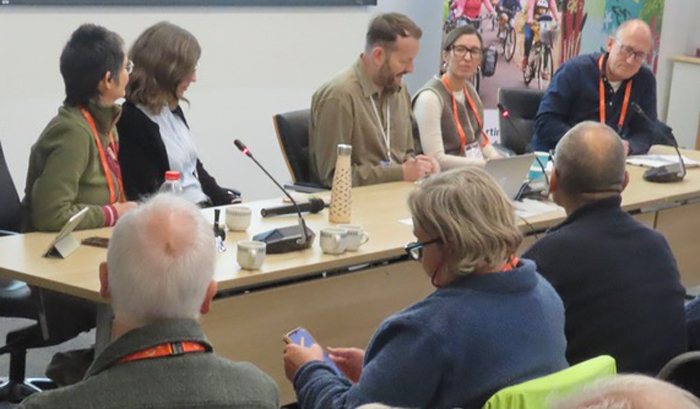
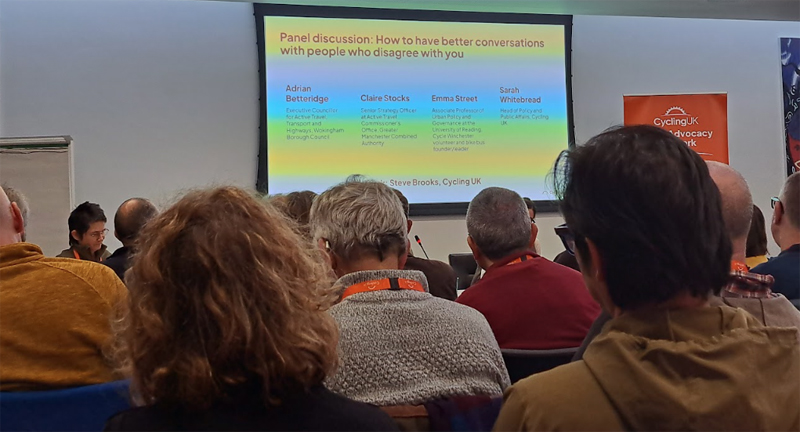
Adrian Betteridge was one of these. Adrian spent a number of years campaigning for better walking and cycling facilities in Wokingham Borough before somehow ending up as Wokingham Council’s Executive Member for Active Travel, Transport and Highways.
Adrian quoted the adage “don’t let perfection be the enemy of good”, noting to get the best overall outcome with the finances available, you some-times have to make compromises.
He also spoke of the natural tendency for people to voice their opinions when they oppose something, rather than when they support it. We have all no doubt seen the rash of negative comments which spring up on social media when Councils propose measures that support Active Travel; Adrian urged campaigners to make voices of support heard as well.
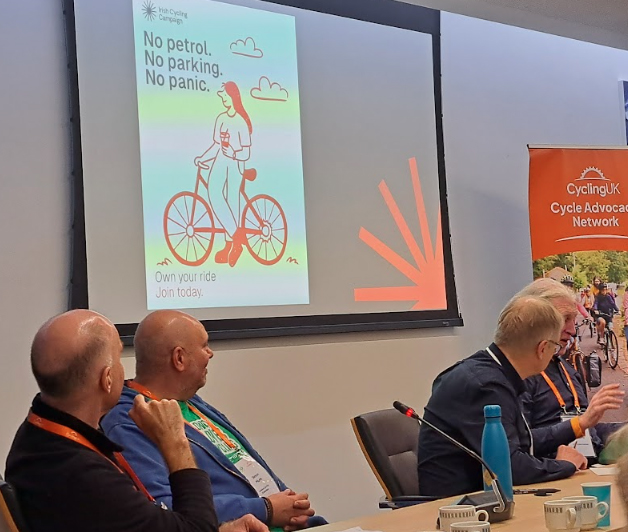
Actively supporting your Council when they are trying to do something good was a theme picked up by several speakers throughout the conference.
Reading’s own Lead Councillor for Climate Strategy and Transport, John Ennis, was one of the delegates at the conference and had also helped us in organising the venue, as had Reading Borough Council’s transport officers, so it was great to see our own Council supporting the conference in this way.
The conference brought together campaigners from across the UK and Ireland, and it was uplifting to hear about the successes which have been achieved by different groups in different parts of the country.
Bike Worcester is promoting bike buses to help kids cycle to school and inspired us with their ‘Room to Ride’ campaign video – this is well worth a watch on YouTube below or via this link: https://tinyurl.com/zxcnfjtp.
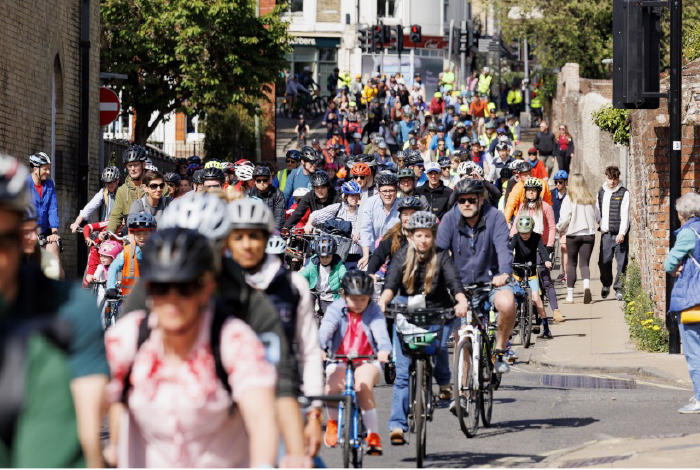
Closer to home Cycle Winchester reported on its annual Mass Ride event. Not a protest ride, just a celebration of cycling by normal people. This year the event attracted a staggering 900+ riders and ended with a Cyclefest in Winchester’s Abbey Gardens (see photo below).
And one final message. At the start of the conference Cycling UK’s Duncan Dollimore had warned that engaging in so-called culture wars, however well-intentioned, only fed the negative narrative.
Simon Munk, Head of Campaigns & Community Development at London Cycling Campaign, gave us his advice on responding to hostile social media comments without feeding the trolls – just post pictures of cats!
Keith Elliott
RCC Secretary

